
It began in rooms that smelled of metal and rain. Engineers in white coats chased a sound no piston could make — a high, liquid scream that lived in circles. The rotary wasn’t just architecture; it was a belief. Mazda built the 787B to last not for a lap, but for a day and a night and a day again.
Carbon monocoque, R26B four‑rotor heart, peripheral ports like open throats singing for air. The assignment was impossible on paper: conquer endurance racing not with cylinders, but with motion that never stops — triangles turning in a perfect dance.
“I remember my first ignition — a shimmer, then fire. I learned my own voice in a fluorescent dawn. They looked at me like I was a question. I answered with song.”
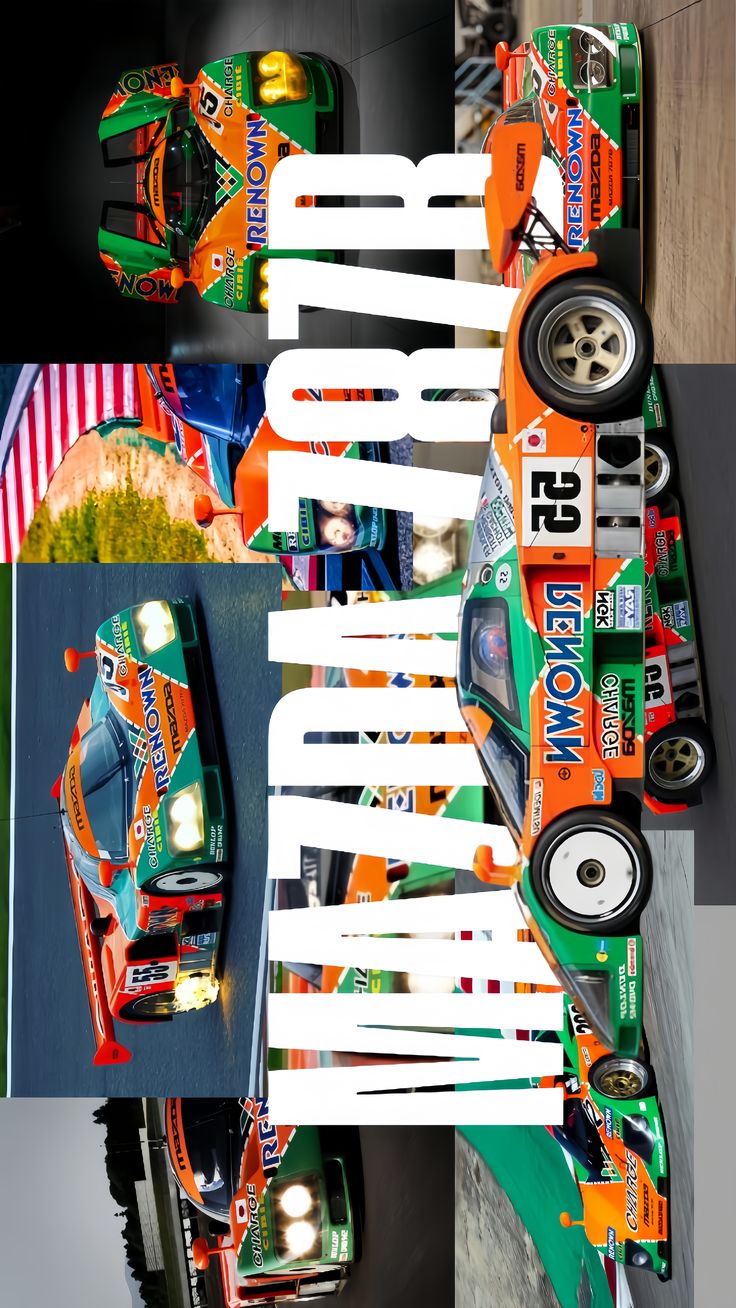
The early races were a mountain made of hours. Against Mercedes, Porsche, and Jaguar, we were an accent in a foreign language. Heat soaked the cockpit. Fuel windows narrowed. A sensor blinked at midnight and a thousand hands reached in with tools that felt like prayers.
There were failures — of gaskets, of gears, of certainty. But in each setback the team learned how to ask the right questions of fate: how hot can a dream run, and still be called reliable? The answer took shape in the hum between sunrise and pit‑lane concrete.
“I carried every DNF like a scar under paint. The giants watched, amused. I watched the horizon. I was built to be patient.”
Green and orange burned against the grey of dawn. Headlights carved tunnels through mist, finding braking boards by memory and faith. The R26B howled above 9,000 rpm — a blade of sound — and the night bent around it. In the pits, hands moved like choreography. Fuel in. Tires on. A nod. Back to the hunt.
Hour 18: fatigue felt like gravity. Hour 22: the track smelled of rubber and stories. Then the final stints — clean, relentless — and the scoreboard told the kind of truth that erases history and rewrites it in the color of your livery.
The checkered flag fell, and for the first time ever, a Japanese car won Le Mans. The world heard a rotary sing victory.
“I didn’t cry. Machines do other things. I cooled. I clicked. I waited for the roar of the crowd to sink into my chassis. I was no longer an experiment. I was an answer.”

They retired me, but never silenced me. My voice lives in Goodwood hillclimbs, in the echo chambers of Gran Turismo, and in the late‑night screens of students who sketch rotor housings where other kids draw hearts. Engineers still walk past my carbon skin and touch it like a relic.
What happened at Le Mans wasn’t just a victory. It was proof that audacity can finish 24 hours ahead of doubt. Mazda’s spirit found a frequency, and I happened to be tuned to it.
“Close your eyes. Hear me. I am still downshifting for Arnage, still full‑throttle past the pits, still turning circles inside circles. I am the 787B — alive, immortal, and racing wherever memory has a track.”